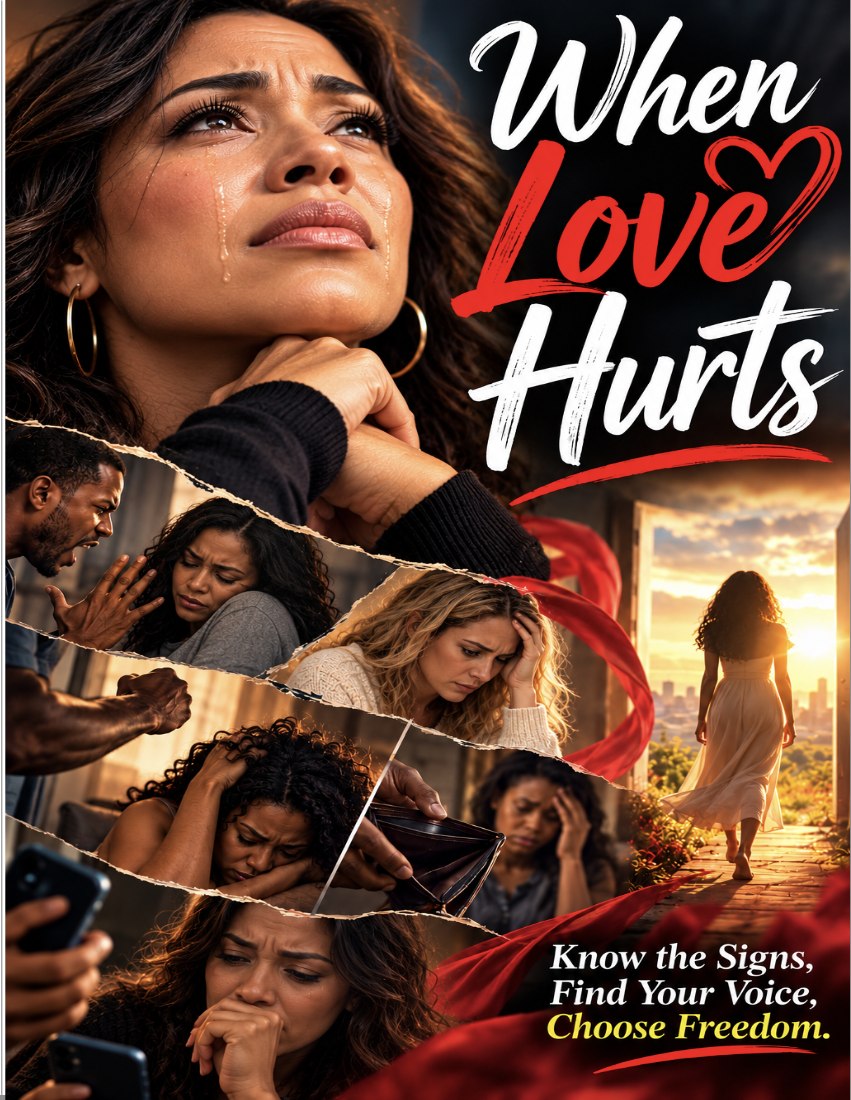
Relationships
When Love Hurts
What God Really Says About Marriage and Abuse
By Dominique Fox · Page 11
About 19 parts · read aloud by a woman's voice
Now reading: When Love Hurts
A word from one who has been there, for every woman who has been told to stay, smile, and suffer in the name of God. Pull up a chair, sweetheart. I want to talk to you the way I wish someone had talked to me forty years ago.
I know what it is to read a magazine like this one with one eye on the door. I know what it is to measure a man's footsteps on the porch and guess his mood before he turns the knob. I learned to rehearse my words in my head before I said them out loud, and I still got them wrong, because there was really no right way to say anything.
I also know what it is to sit in a pastor's office with my hands folded in my lap and be told to go home, pray harder, submit more, and keep my vows "no matter what." I went home. I prayed harder. I submitted more. And it got worse.
So before I say anything else, let this settle into your bones: what is happening to you is not God's will, and it is not your fault. The God who made marriage did not design it to be a place where you are hurt, frightened, controlled, or erased. You are not crazy. You are not too sensitive. And you are not failing God by wanting to be safe or by wanting the pain to stop.
I'm in my late sixties now. I'm a counselor and a minister, a mother to a grown son and daughter, and a grandmother of a beautiful granddaughter. But I got here by way of some very dark roads, including a shelter cot and some nights with no roof at all. I'm not writing to you from a pedestal. I'm writing to you from the other side of the same valley you're standing in. And I promise you, there is another side.
Safety first: If someone checks your phone, computer, or browser history, consider reading this on a device he cannot access, such as a trusted friend's phone or a library computer. If you are in danger right now, call 911.
Calling It by Its Name
For years I didn't have a word for what was happening to me. He only put his hands on me a few times, I told myself. The rest was just his temper. Just his way. Just a hard season. It took a counselor at the shelter, a soft-spoken woman with reading glasses on a beaded chain, to look me in the eye and say, "Honey, that's abuse." I cried for an hour. Not because it hurt to hear it, but because somebody finally said it out loud.
So let me be that woman for you. Domestic violence is a pattern of behavior one partner uses to gain and keep power and control over the other. It is not a bad day, a heated argument, or a rough season. It is a pattern, and the pattern is the point.
Many women in the church never use the word abuse because no one ever showed them what it looks like when it doesn't leave a bruise. Abuse can take many forms:
- Physical: hitting, pushing, choking, restraining, throwing things, blocking the door, reckless driving to frighten you.
- Emotional and verbal: name-calling, constant criticism, humiliation in front of others, threats, mind games that leave you doubting your own memory.
- Isolation: cutting you off from family, friends, or even church; monitoring your calls, location, and messages.
- Financial: controlling every dollar, hiding money, sabotaging your job, forcing you to beg for necessities. (I once had to ask permission to buy my daughter a winter coat.)
- Sexual: pressuring, coercing, or forcing intimacy. NEWSFLASH: Marriage does not cancel consent.
- Spiritual: twisting Scripture to demand obedience, using God as a weapon, threatening you with hell or church discipline for speaking up, keeping you from worship.
If you recognized your home in that list, take a breath. I'm right here. Naming it is not betrayal. Naming it is the first step toward truth, and Jesus said the truth is what sets us free (John 8:32).
Untangling the Lies: Myths Told in God's Name
Some of the heaviest chains I ever wore were forged in the pulpit, not the kitchen. I believed every one of these myths at one time or another. Let's take them off you, one link at a time.
Myth 1: "God hates divorce, so you have to stay." I heard Malachi 2:16 so many times I could recite it in my sleep, always the first half. Nobody ever read me the rest. Many translations render it this way: God hates divorce and the man who "covers his garment with violence." The prophet was rebuking husbands who treacherously abandoned and wronged their wives. He was not handing abusers a contract that locks their wives inside. God hates what destroys covenant. And guess what — violence destroys covenant. Faithful Christians disagree about when divorce is permitted, but no faithful reading of Scripture requires you to remain in physical danger. Separation for safety is not sin.
Myth 2: "If you submitted better, he wouldn't get so angry." Oh, sweetheart, I tried. I ironed his shirts just so. I kept the children quiet. I learned to cook his mother's recipes. And the abuse kept coming, because it was never about the dinner. Abuse is a choice the abuser makes. It is not a reaction you cause. Ephesians 5 never tells a wife to earn safety through performance. It tells a husband to love his wife "as Christ loved the church and gave himself up for her" (Ephesians 5:25). Christ gave himself up. He did not demand that the church give herself up for him.
Myth 3: "It isn't abuse if he never hits you." The words left deeper scars on me than his hands ever did. I can still hear some of them. Scripture takes words seriously: "Death and life are in the power of the tongue" (Proverbs 18:21). Colossians 3:19 commands husbands, "love your wives, and do not be harsh with them." A man who breaks your spirit with words, controls your money, and isolates you from your people is violating the covenant as surely as a man who raises his hand.
Myth 4: "This is your cross to bear." Jesus calls us to suffer for righteousness' sake, not to absorb sin so that sin can keep growing. 1 Peter 3 is often used to tell wives to endure quietly, but the same chapter warns husbands that if they do not honor their wives, their own prayers will be hindered (1 Peter 3:7). My silence was not holiness. Looking back, I can see it was the very soil his abuse grew in.
Myth 5: "If you truly forgave him, you would stay." This is the one I counsel women through most often. Forgiveness, reconciliation, and trust are three different things. Forgiveness releases the debt to God; you can do it from a safe distance. I forgave that man years ago, from across town, and I sleep just fine. Reconciliation requires genuine repentance on his part, and repentance is proven by changed behavior over time, not tears and flowers after an explosion. Trust is rebuilt slowly and must be earned. You can forgive a man and still never give him access to harm you again.
Myth 6: "What happens in this house stays in this house." Secrecy protects abusers, not marriages. I kept his secrets for years, and all it got me was more years of the same. Jesus taught that unrepentant sin is to be brought into the light (Matthew 18:15–17). Romans 13:3–4 describes civil authorities as God's servants for restraining wrongdoing. Calling the police, telling a trusted friend, or speaking with an advocate is not disloyalty. It is wisdom.
Myth 7: "Leaving shows a lack of faith." The night I finally left, I was sure God was disappointed in me. Then I went back to my Bible and found it full of faithful people who fled danger. David escaped Saul's spear, and his wife Michal helped him through a window (1 Samuel 19:10–12). Paul was lowered over the Damascus wall in a basket to escape those plotting to kill him (Acts 9:23–25). Joseph and Mary fled to Egypt to protect their child (Matthew 2:13–14). "The prudent sees danger and hides himself" (Proverbs 22:3). Running from danger is not running from God.
Myth 8: "The children need their father in the home." I stayed longer than I should have for my son and my daughter. What I didn't understand then is that they were watching everything. Children need safety more than they need a particular arrangement, and children who live with abuse are harmed by it, whether or not they are struck themselves. Protecting them is not breaking up a family. It is guarding the ones God placed in your care. Today my children are grown, and they've both told me the bravest thing I ever did was walk out that door with them.
What Godly Marriage Is, and What It Is Not
Here is something I didn't learn until I was nearly fifty: I had never actually seen a godly marriage up close. I'd only seen what people called one. It wasn't until I spent time around a couple at my second church, an older pair who still held hands in the parking lot, that I understood what God had in mind all along.
God's design for marriage is a covenant of mutual love, honor, and self-giving, a living picture of Christ's love for His people. When one partner turns that covenant into a cage, it is the abuser who has broken the vow, not the woman who seeks safety.
1 Corinthians 13 gives us the measuring stick: love is patient and kind; it does not insist on its own way; it is not irritable or resentful. Ephesians 5:28–29 adds that a husband should love his wife as his own body, nourishing and cherishing her. In my counseling office, I ask women to hold their marriage up to that light, honestly, with no one watching but God.
- Godly marriage IS mutual submission "out of reverence for Christ" (Ephesians 5:21) — it is NOT one-way obedience demanded by force or fear.
- It IS servant leadership that lays down its life (Ephesians 5:25) — NOT headship used as a license to control.
- It IS nourishing and cherishing (Ephesians 5:29) — NOT belittling, starving, or neglecting.
- It IS two becoming one, each fully seen (Genesis 2:24) — NOT one person disappearing so the other can dominate.
- It IS honor that keeps prayers unhindered (1 Peter 3:7) — NOT harshness, threats, and intimidation (Colossians 3:19).
- It IS freedom to grow, worship, and serve God — NOT isolation from family, friends, and church.
- It IS a safe refuge — NOT a place you are afraid to come home to.
Let's talk about Sapphira in Acts 5 — she went along with her husband's sin and was held accountable for her own choice (Acts 5:1–10). Submission to a husband never means submission to sin. "We must obey God rather than men" (Acts 5:29). I wish someone had shown me that passage when I was twenty-five.
When the Church Gets It Wrong
Some of you were hurt twice: once at home, and again when you reached out for help. I know that second wound well. When I finally worked up the courage to tell a church leader the truth, he told me to be a better wife and to stop "gossiping" about my husband. Then he suggested we come in together for counseling. I sat in that session next to the man who frightened me and said nothing true, because I knew I would pay for every word in the car on the way home.
Perhaps you've been warned that leaving would bring shame on the ministry. Let me say this plainly, as a minister myself: the church should have been your shelter. Jesus reserved His sharpest words for religious leaders who laid heavy burdens on people's shoulders and would not lift a finger to help (Matthew 23:4). The Good Shepherd goes after the wounded sheep. He does not send her back to the wolf.
- Couples counseling is not recommended when abuse is present. I say this now as a counselor, not just a survivor. It can put you at greater risk, because what you say in the session can be punished at home. Individual counseling, for each of you separately, is the safer path.
- Your pastor's opinion is not the final word on your safety. Seek leaders who will believe you, protect you, and hold the abuser accountable.
- God sees. He is "El Roi," the God who saw Hagar when she fled into the wilderness (Genesis 16:13). He saw me on a shelter cot with my children asleep beside me. He sees you too.
If your church cannot be a safe place right now, that does not mean God has abandoned you. It may mean He is leading you to some others who will carry you well. He led me to a shelter chaplain, a handful of fierce women, and eventually to a congregation that held me up while I learned to stand.
Wisdom for the Road Ahead
When I left, I left with two children, one bag, and no plan. We spent some nights in my car before we found a bed at a shelter. I don't tell you that to frighten you. I tell you because I want better for you than I had. God gives wisdom generously to anyone who asks (James 1:5), and wisdom includes practical steps. You do not have to have everything figured out today. You only need the next faithful step.
- Talk to a trained advocate. Hotline advocates are free, confidential, and available around the clock. They will not pressure you to leave. They will help you think through your options and build a safety plan that fits your life.
- Plan before you act. The time around leaving can be the most dangerous period in an abusive relationship. A safety plan, made with an advocate, matters.
- Gather what you can quietly. Over time, set aside copies of IDs, birth certificates, insurance cards, bank information, medications, a little cash, and a spare phone charger with someone you trust. I didn't have my children's birth certificates for months, and it made everything harder.
- Document what happens. Dates, photos, messages, and medical records can matter later for protective orders and custody.
- Choose a safe person. Tell one trusted friend, family member, or leader what is happening, and agree on a code word that means "call for help."
- Know your legal options. Protective orders exist to keep you safe. An advocate can explain the process where you live.
And as you walk, let these promises go with you. I wrote them on an index card and kept it in my coat pocket for years:
The LORD is near to the brokenhearted and saves the crushed in spirit.
— Psalm 34:18
He heals the brokenhearted and binds up their wounds.
— Psalm 147:3
Healing is not a straight line. Some days you will feel strong, and some days you will miss the man you hoped he would become. I did. That grief is real, and it is not a sign you chose wrong. It is the sound of a heart that loved, and a heart God intends to restore.
A Closing Word to Your Heart
Last spring my granddaughter climbed into my lap and asked me why I always say "you are safe here" when she visits. I told her it's because every little girl, and every grown woman, deserves to hear those words and know they're true. I'm saying them to you now.
Daughter, you were created in the image of God (Genesis 1:27). You were bought at a price (1 Corinthians 6:20). Your body is a temple of the Holy Spirit, not a target. Your voice was given to you by the One who spoke the world into being, and no man has the right to silence it.
Choosing safety is not abandoning your faith. It may be the bravest act of faith you will ever take. The same God who parted the sea for Israel can make a way where you see none. Sometimes the way He makes looks like a phone call, a shelter bed, an open door, and a friend who says, "Come stay with me." I know, because that's exactly what His way looked like for me.
You are not alone. You are not forgotten. And you are not too far gone. There is no judgment here, only an open hand. Take the next step. Heaven is on your side, and so am I.
With love, Dominique
Where to Find Help
I didn't know any of these numbers existed when I needed them. Now you do. All of these services are free and confidential. If your phone or computer may be monitored, use a safe device, and consider texting or chatting instead of calling.
- Emergency services — Call 911. Immediate danger, anywhere in the U.S.
- National Domestic Violence Hotline — Call 1-800-799-7233 (1-800-799-SAFE) · Text START to 88788 · Live chat at thehotline.org. 24/7 crisis support, safety planning, and referrals to local shelters; service in English, Spanish, and many other languages.
- Deaf and hard of hearing — TTY 1-800-787-3224 · Video phone 1-855-812-1001. 24/7 support for Deaf, DeafBlind, and hard of hearing survivors.
- StrongHearts Native Helpline — Call or text 1-844-762-8483 (1-844-7NATIVE). 24/7 support for Native American and Alaska Native survivors.
- Georgia Statewide Domestic Violence Hotline (GCADV) — Call 1-800-33-HAVEN (1-800-334-2836). 24/7; connects you to the nearest certified shelter in Georgia.
- National Sexual Assault Hotline (RAINN) — Call 1-800-656-4673. 24/7 support for sexual violence, including within marriage.
- love is respect — Call 1-866-331-9474 · Text LOVEIS to 22522. Support for teens and young adults in abusive dating relationships.
- 988 Suicide & Crisis Lifeline — Call or text 988. 24/7 support if you are in emotional crisis or having thoughts of harming yourself.
- WomensLaw.org — plain-language information on protective orders and legal options, state by state.
- TechSafety.org — guidance on staying safe when devices or accounts may be monitored.
Outside the United States? Call your local emergency number, and search for your country's national domestic violence helpline from a safe device. Need prayer and pastoral support? Find a church or ministry that will believe you and walk with you — alongside, not instead of, the trained advocates above.
"Choosing safety is not abandoning your faith. It may be the bravest act of faith you will ever take."
Scripture quotations are from the English Standard Version (ESV).
From our advertisers

BibleGateway+
"The Best Value in Digital Bible Study" — a digital Bible study subscription. The print page carried the note that it is editorially selected, not a paid advertisement.
Visit BibleGateway