Bible Study
Three Women of the Bible Nobody Preaches About
(But Somebody Should)
By Pastor Deb · Page 20
About 14 parts · read aloud by a woman's voice
Now reading: Three Women of the Bible Nobody Preaches About
Let me tell you something, sis. The Bible has a whole lineup of women, and every year we keep sending the same five to the podium.
Esther gets the crown. Ruth gets the wedding. Mary gets the manger. The Proverbs 31 woman gets the Mother's Day program, the plaque, the mug, and the sermon that makes every woman in the building feel like she's already behind on her linen production. And don't get me started on Martha. That poor woman has been getting dragged for being busy in the kitchen for two thousand years, and some of y'all still ate the food.
I love all of them. But tucked in the corners of Joshua and Second Samuel are women whose stories are so bold, so strange, and so Holy Ghost-relevant that I'm convinced they got skipped because the preacher ran out of time and the choir was already standing up.
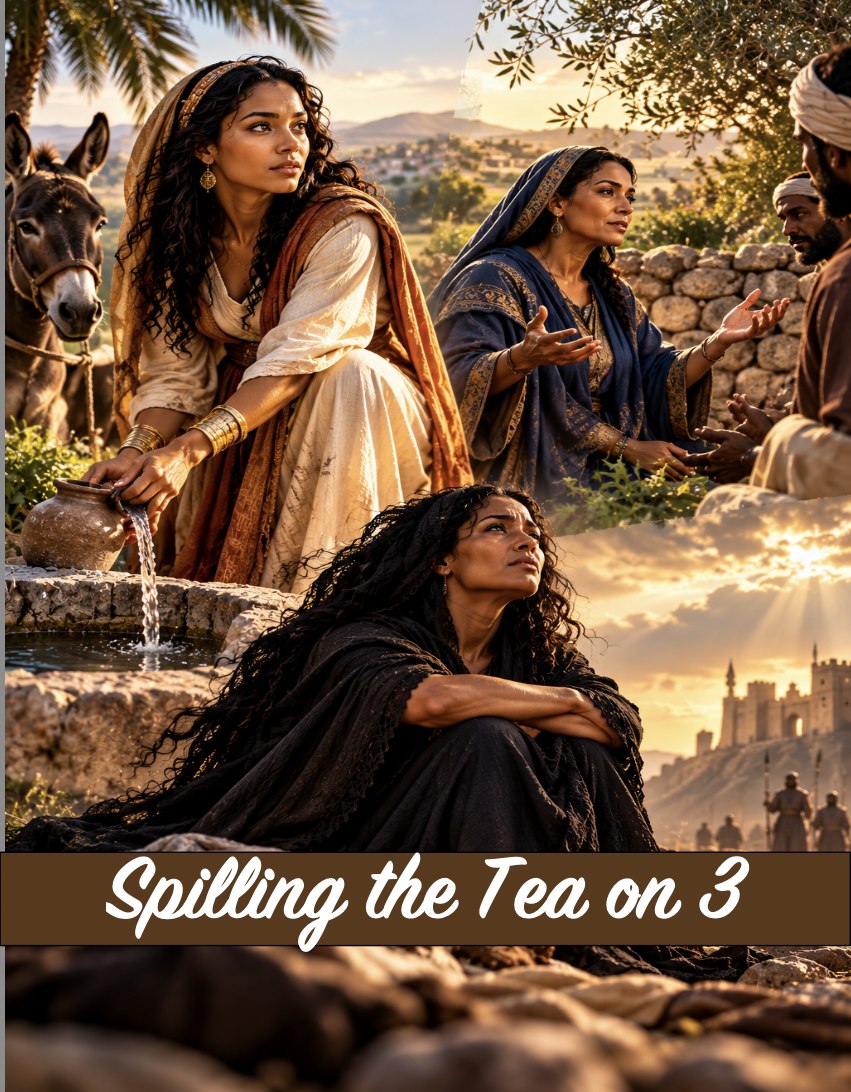
So pour yourself a cup. Today we're spilling the tea on three women most folks have never heard preached: Achsah, the daughter who asked for more; the Wise Woman of Abel, who stopped a war with one conversation; and Rizpah, the mother who sat on a rock until a king had to pay attention.
None of them got a book named after them. All of them moved heaven and earth anyway.
1. Achsah: The Woman Who Got Off the Donkey and Asked for the Water
Joshua 15:13–19; Judges 1:12–15
Achsah was the daughter of Caleb. Yes, that Caleb. The eighty-five-year-old spy who looked at a mountain full of giants and said, "Give me this mountain" (Joshua 14:12). So you already know this girl was raised in a house where nobody whispered their requests.
Caleb announces a challenge: whoever captures the city of Kiriath-sepher gets Achsah as his wife. Now before somebody throws their coffee at me, yes, that's ancient Near Eastern marriage culture and no, I'm not recommending it for your daughter's dating life. But watch what God does inside that culture.
Othniel, Caleb's nephew, takes the city and gets the bride. Here's where it gets good. Scripture says that when she came to him, she moved him to ask her father for a field (Joshua 15:18). Translation: she nudged her husband. And when the husband apparently didn't move fast enough, Achsah handled it herself.
She climbs down off her donkey. Caleb, who has raised this child and knows that look, says, "What wouldst thou?" In other words: Uh oh. What do you want?
And she says, "Give me a blessing; for thou hast given me a south land; give me also springs of water" (Joshua 15:19).
The "south land" was the Negev. Dry. Dusty. Beautiful on a postcard, impossible to farm. Daddy gave her land, and she said, Thank you, now where's the plumbing? And Caleb gave her the upper springs AND the nether springs. She asked for water and got a double portion.
Oh, and that husband she nudged? Othniel became the very first judge of Israel (Judges 3:9–11), and the land had rest forty years. Behind that man was a woman who knew how to ask.
The Lessons
- Gratitude and asking for more are not enemies. Achsah didn't refuse the land or complain about it. She received it and then said, it needs water to live. Some of us have been taught that asking for more is ungrateful. No, ma'am. Jesus Himself said, "Ask, and it shall be given you" (Matthew 7:7). And James put it plainer: "Ye have not, because ye ask not" (James 4:2).
- A gift without a source becomes a burden. Land without water is just a very large sandbox. Ministry without the Holy Spirit is the same. Some of us are holding assignments God gave us and wondering why they feel so dry. Get off the donkey and ask your Father for springs.
- Know whose daughter you are. Achsah asked boldly because she knew her father. You and I have a Father who "shall give good things to them that ask him" (Matthew 7:11). Your boldness should be proportional to your confidence in His character.
Real Life, Real Talk
Achsah is the woman who got the job offer and, instead of fainting with gratitude, said, "I'm thrilled to accept. Now let's talk about the salary, the benefits, and that remote Friday." She didn't lose the job. She got the springs.
She's the one who bought the fixer-upper and called the realtor back about the well. She's the church member who said yes to leading the youth ministry and then walked into the budget meeting with a folder.
And she's the woman who stopped praying, "Lord, just help me make it," and started praying, "Lord, You gave me this land. Now give me the water to make it bloom."
Baby, it's not greed if you're asking for what the assignment needs. It's stewardship with good posture.
2. The Wise Woman of Abel: She Ended a War Over the Back Fence
2 Samuel 20:14–22
She doesn't even get a name. The Bible just calls her "a wise woman." Honestly? If I had to choose between a name and that title, I'd take the title.
Here's the setup. David's kingdom is barely recovering from Absalom's rebellion when a troublemaker named Sheba, son of Bichri, blows a trumpet and starts another rebellion. Some folks just can't let a church business meeting end peacefully.
Sheba runs and hides inside the city of Abel of Beth-maachah. Right behind him comes Joab, David's general, with an army. And let me give you Joab's résumé from earlier in that very same chapter: he walked up to his own cousin Amasa, took him by the beard like he was going in for a holy kiss, and stabbed him (2 Samuel 20:9–10). That's who's at the gate. Joab's men build a siege ramp and start battering the wall.
And then, from up on that wall, a woman yells, "Hear, hear!" (verse 16). She asks for Joab by name. "Art thou Joab?" Ma'am. Are you checking ID on a man holding a battering ram?
She reminds him that Abel has a reputation as a place people come to settle matters wisely. She says, "I am one of them that are peaceable and faithful in Israel: thou seekest to destroy a city and a mother in Israel: why wilt thou swallow up the inheritance of the LORD?" (verse 19).
Joab blinks and essentially says, Whoa, whoa, it's not personal. I just want Sheba. And she says, "Behold, his head shall be thrown to thee over the wall" (verse 21).
She goes back inside, talks to her people "in her wisdom," and before you can say "meeting adjourned," Sheba's head comes flying over the wall. Joab blows the trumpet, the army packs up, and everybody goes home. One woman. One conversation. Zero casualties for the city.
Now I'm not telling you to throw anybody's head over anything. Put the scissors down. But I am telling you this woman negotiated a ceasefire with the most dangerous man in Israel and still had time to make dinner.
The Lessons
- Go to the person who can actually fix it. She didn't scream at the soldiers. She didn't post on the city bulletin board. She asked for Joab. Jesus gave us the same playbook in Matthew 18:15: go to the person directly. Talking about the problem to everybody except the person in charge is not prayer. It's gossip with a prayer request label.
- Separate the problem from the people. Joab wasn't after the city. He was after one man. She was wise enough to ask, What exactly do you want? before the whole town got leveled over one rebel. Some of us are about to burn down a marriage, a friendship, or a ministry over one issue we never actually named.
- Soft words, steel spine. "A soft answer turneth away wrath" (Proverbs 15:1). But don't confuse soft with weak. She stood on a wall facing an army and spoke calmly. That's the woman of Proverbs 31:26: "She openeth her mouth with wisdom; and in her tongue is the law of kindness."
- Know your heritage and use it. She reminded Joab who Abel was: a city of counsel, a mother in Israel, part of the Lord's inheritance. When the enemy comes to batter your walls, remind him whose inheritance you are.
Real Life, Real Talk
The Wise Woman of Abel is the HOA meeting where everybody's yelling about the fence, the dogs, and the dumpster, and one lady raises her hand and says, "Okay. What is the one thing we need to decide tonight?" Twenty minutes later, everybody's home.
She's the coworker who, instead of joining the break-room complaint choir, schedules fifteen minutes with the manager and walks out with the problem solved.
She's the church mother who hears that the deacons and the praise team are about to split the congregation over the sound board, and she calls both sides into her kitchen. Nobody leaves until the pound cake is gone and the peace is made.
She's the mama who looks at the teenager slamming doors and asks, "Baby, what is this really about?" And it turns out it was never the dishes.
Wisdom doesn't always need a pulpit. Sometimes it just needs a wall, a voice, and the courage to say, "Hear, hear."
3. Rizpah: The Mother Who Sat on a Rock Until the King Got Up
2 Samuel 3:7; 2 Samuel 21:1–14
I'm going to slow the music down for this one, because Rizpah's story is heavy. But stay with me. Her ending will preach.
Rizpah was a concubine of King Saul. The first time we meet her (2 Samuel 3:7), she isn't speaking. She's being argued over by powerful men: Saul's son Ish-bosheth accuses General Abner of sleeping with her, and Abner gets so offended he switches his loyalty to David. Rizpah is the topic of the meeting, but nobody invited her to the meeting. Some of y'all know that feeling.
Years later, Israel suffers a three-year famine. David seeks the Lord, and God reveals that it's tied to Saul's bloodguilt: Saul had slaughtered the Gibeonites, a people Israel had sworn by covenant to protect (Joshua 9). The Gibeonites demand seven of Saul's descendants. David hands them over, including Rizpah's two sons, Armoni and Mephibosheth (not Jonathan's son — a different Mephibosheth, because apparently that family only had one baby-name book). The seven are executed and their bodies are left exposed on a hill at the beginning of barley harvest.
And here is what Rizpah does. She takes sackcloth, spreads it on a rock, and she sits there. Scripture says she stayed "from the beginning of harvest until water dropped upon them out of heaven," and she "suffered neither the birds of the air to rest on them by day, nor the beasts of the field by night" (2 Samuel 21:10).
Barley harvest begins in spring. The rains in Israel don't usually come until fall. Scholars debate the exact length, but this may have been months. A grieving mother, waving off vultures by day and jackals by night. No signs. No microphone. No hashtag. Just presence.
And somebody finally told the king.
When David hears what Rizpah has done, it moves him. He goes and recovers the bones of Saul and Jonathan from Jabesh-gilead, gathers the bones of the seven, and gives them all a proper burial in the family tomb of Kish. And then comes the line that makes me shout: "And after that God was intreated for the land" (2 Samuel 21:14).
The famine broke after a woman refused to leave the rock.
The Lessons
- Faithful presence is a form of protest and a form of prayer. Rizpah never gives a speech. Not one word of hers is recorded in the whole Bible. Yet her vigil moved a king and preceded the healing of a nation. Never underestimate the power of the woman who simply refuses to leave.
- God sees the women history treats as footnotes. The men talked over her in chapter 3. In chapter 21, the Holy Spirit made sure the whole world would know her name and what she did. "Thou God seest me" (Genesis 16:13) wasn't just Hagar's testimony.
- Dignity is worth defending, even when you can't change the outcome. Rizpah couldn't bring her sons back. But she could make sure they were not dishonored. Sometimes faithfulness is not fixing it. Sometimes it's guarding what's left until help comes.
- Your persistence can wake up people with power. Like the persistent widow in Luke 18:1–8, Rizpah teaches us that "men ought always to pray, and not to faint." Keep sitting on that rock. The rain is coming.
Real Life, Real Talk
Rizpah is the mother who has shown up to every single court date for her son. Same seat. Same Bible. The clerks know her name now. She can't control the verdict, but she will not let that system forget he has a mother.
She's the wife sitting in the ICU waiting room for the forty-third day, the one the nurses bring coffee to without asking.
She's the grandmother who goes to every city council meeting about the dangerous intersection where her grandbaby was hit. They groan when she walks in. Two years later, there's a traffic light. That light is her rock.
And she's every woman who has prayed one prayer for so long that the angels have it memorized. Sis, don't get off the rock. You don't have to be loud to be powerful. You just have to stay.
The Last Sip
So here's the tea, steeped and strained.
Achsah teaches us to ask. Get off the donkey, look your Father in the face, and request the springs your assignment needs.
The Wise Woman of Abel teaches us to speak. Calmly, directly, to the right person, about the real problem, before somebody tears the whole wall down.
Rizpah teaches us to stay. When you can't fix it and can't explain it, you can still show up, guard what matters, and wait for the rain.
Ask. Speak. Stay. One woman got water in a desert. One woman got peace in a war. One woman got rain in a famine. Not one of them had a platform, a title, or a speaking slot at the women's conference. They had faith, nerve, and a God who was paying attention.
And He's paying attention to you, too, even if your name never makes the program.
Now go on, sis. Somebody's waiting on your springs, your wisdom, and your rock.
Selah, and pass the honey.
"None of them got a book named after them. All of them moved heaven and earth anyway."