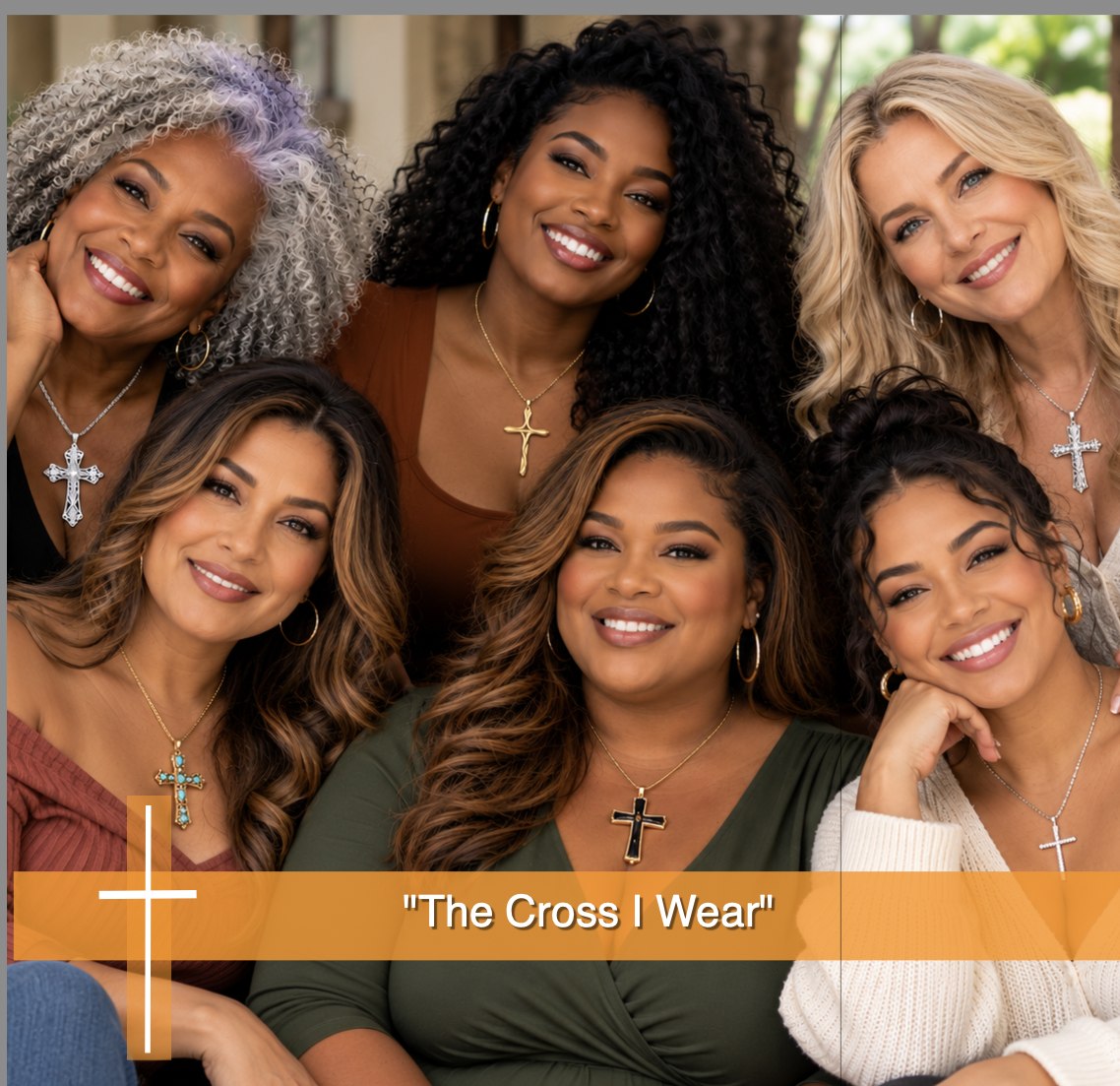
Faith & Doctrine
The Cross I Wear
It Doesn't Celebrate How He Died. It Declares Why I Live.
By SHE TEA · Page 36
About 16 parts · read aloud by a woman's voice
Now reading: The Cross I Wear
Some people wear designer labels to show who made their clothes. I wear the cross to remind me Who remade my life.
Now, before somebody gets offended, let me explain. Because when you really stop and think about it, wearing a cross around your neck is a rather interesting Christian tradition.
Think about it.
The cross was an instrument of execution. It was Rome's way of publicly humiliating, torturing, and killing people. It wasn't decorative. It wasn't fashionable. And it certainly wasn't something anybody wanted to be associated with.
So why in the world would Christians turn an ancient instrument of death into one of the most recognizable symbols of their faith?
Imagine someone walking into church wearing a miniature electric chair on a gold chain. Or a pair of earrings shaped like a guillotine. Somebody would be whispering, "Baby, are you okay? Do we need to pray for you?"
Yet here we are, proudly wearing crosses made of gold, silver, diamonds, and even wood. And perhaps the question deserves an answer. Why do we wear the cross? Well, I'm glad you asked.
You See an Execution. I See a Redemption.
Here is where the revelation begins. I'm not wearing what was done to Jesus. I'm wearing a reminder of what Jesus accomplished through it. There's a difference, and it's a mighty big one.
Rome intended the cross to be a symbol of shame, punishment, and defeat. But through the willing sacrifice of Jesus Christ, what humanity intended for humiliation became the place where God's redemptive plan was accomplished. Now that's what I call a divine reversal!
The very instrument designed to announce, "This man has been defeated," became the symbol through which believers proclaim, "Our Savior has conquered!"
But God forbid that I should glory, save in the cross of our Lord Jesus Christ.
— Galatians 6:14 (KJV)
Now, Paul had quite the résumé. Education, religious credentials, influence, and accomplishments. If anybody could have boasted about his personal achievements, Paul could. But when it came to what mattered eternally, Paul said, in essence, "You can keep the accolades. My boast is in the cross."
Why? Because Paul understood something we sometimes forget. The cross wasn't evidence of Christ's weakness. It was a demonstration of His willing sacrifice and God's power to save.
First Corinthians 1:18 tells us that the message of the cross is foolishness to those who are perishing, but to those being saved, it is the power of God. In other words, what looks ridiculous to someone who doesn't understand redemption becomes revolutionary to someone who has experienced it. And family, that's worth talking about.
The Nails Didn't Make Him Stay
Now here's something that ought to make us think. Jesus wasn't an unwilling victim caught in circumstances beyond His control. He knew what was coming. He knew betrayal was coming. He knew the accusations were coming. He knew the mocking, the whipping, the crown of thorns, and the nails were coming. And He went anyway.
No man taketh it from me, but I lay it down of myself.
— John 10:18 (KJV)
Let that settle in your spirit. The soldiers drove the nails, but the nails weren't what kept Him committed to the cross. Love kept Him committed to the mission. Obedience brought Him to Calvary. And redemption was the purpose.
Now, I know we love to talk about how much Jesus suffered. And we should never minimize that suffering. But don't become so consumed with the brutality of His death that you miss the beauty of His willingness. He wasn't merely enduring something terrible. He was accomplishing something eternal.
And here's the part that gets me every time. While hanging on that cross, Jesus prayed: "Father, forgive them; for they know not what they do." — Luke 23:34 (KJV)
Excuse me? These people are actively participating in your execution, and you're praying for their forgiveness? Most of us have trouble forgiving somebody who didn't speak to us at the grocery store! Somebody cuts us off in traffic, and suddenly we're asking God to work on their attitude while conveniently overlooking our own.
Yet Jesus, in the middle of unimaginable suffering, demonstrated a love that refused to surrender its purpose. That's not ordinary love. That's redeeming love. Catch this: Calvary wasn't love talking. It was love demonstrating.
Romans 5:8 reminds us that God demonstrated His love toward us in that while we were still sinners, Christ died for us. Not after we cleaned ourselves up. Not after we became worthy. Not after we learned all the church songs, memorized twenty scriptures, and mastered the art of saying "Hallelujah" at just the right moment. While we were still sinners. Now THAT is love.
When Justice and Mercy Met at Calvary
Here is where the cross becomes even more profound. God is holy. God is just. And God is merciful. Those truths do not compete with one another. At Calvary, we see how God's justice against sin and His mercy toward sinners come together through Jesus Christ.
Romans 3:25–26 explains that God presented Christ as the atoning sacrifice so that He would be both just and the One who justifies those who have faith in Jesus. In plain language? God didn't have to abandon His justice to extend His mercy. Jesus satisfied what we could never satisfy ourselves.
And that's important because grace isn't God pretending sin doesn't matter. Forgiveness isn't God looking the other way. And salvation isn't Heaven running a clearance sale where everybody gets redemption because the price has been marked down.
No, ma'am. No, sir. The price was not reduced. The price was paid. First Peter 2:24 tells us that Jesus bore our sins in His own body on the tree. Second Corinthians 5:21 teaches that the One who knew no sin was made sin for us, so that in Him we might become the righteousness of God.
Think about that exchange. He took what belonged to us so that, through faith in Him, we could receive what we could never earn. Our sin. His sacrifice. Our guilt. His righteousness. Our condemnation. His offer of reconciliation.
And just before He died, Jesus declared: "It is finished." — John 19:30. Not "I'm finished." IT is finished. His earthly mission of sacrificial obedience had reached its appointed completion. The sacrifice had been offered. And the resurrection would publicly vindicate the One who offered it.
So when I look at the cross, I don't see a helpless Savior who lost a battle. I see the Son of God who willingly gave His life to accomplish what no religious ceremony, human achievement, or personal goodness could ever accomplish. My salvation wasn't purchased on a discount. It was paid for by a Savior.
Friday Was Real. But Friday Wasn't Final.
Now, we cannot tell the story of the cross and leave Jesus in the grave. Because if the story ended at Calvary, Christianity would have a very different message. Paul makes that abundantly clear in 1 Corinthians 15:17: "And if Christ be not raised, your faith is vain; ye are yet in your sins." (KJV)
There it is. No resurrection, no victorious Christian message. But the Gospel declares that Jesus rose from the dead. The same Jesus who was crucified was raised to life. The tomb that received His body could not hold Him. And the stone that sealed the entrance did not have the final word.
Now, let's be clear. Jesus didn't need the stone rolled away to make His resurrection possible. The stone's removal revealed that the tomb was already empty. And what a revelation that is! The cross tells me what He paid. The empty tomb tells me He lives.
Romans 4:25 tells us Jesus was delivered over for our offenses and raised for our justification. And 1 Corinthians 15:54–57 celebrates the victory God gives us through our Lord Jesus Christ. So yes, Friday was painful. Friday was dark. Friday looked devastating. But Friday wasn't the conclusion.
And somebody reading this needs to hear that for more than theological reasons. Because perhaps you're living through a Friday right now. Something has ended. Something has broken. Something you believed would last has been buried beneath disappointment, grief, or regret.
Now, I'm not going to insult your intelligence or your pain by telling you that every Friday guarantees an earthly Sunday exactly the way you want it. That's not what Scripture promises. But the resurrection does assure us that suffering and death do not have ultimate authority over those who belong to Christ.
Our hope isn't that every circumstance will turn around by Sunday morning. Our hope is that the Savior who rose on Sunday morning will never abandon us, even when our circumstances don't change. That's resurrection hope. And it's bigger than a temporary turnaround.
Don't Confuse the Symbol with the Savior
Now, before somebody runs out and purchases a cross large enough to require its own seat belt, we need to establish something important. The cross hanging around your neck has no supernatural power of its own. It cannot forgive sin. It cannot guarantee protection. It cannot make you holy. And it certainly cannot replace a relationship with Jesus Christ.
A diamond-studded cross doesn't give you premium access to Heaven. And a cross from the dollar store doesn't make your faith any less valuable. Because salvation has never been about the price of the jewelry. It's about the price Christ paid.
Ephesians 2:8–9 reminds us that we are saved by grace through faith, not by works. And Acts 4:12 declares that salvation is found in no other name than Jesus Christ. So let's settle this. The cross is not my idol. Christ is my Savior.
I don't trust the metal. I trust the Messiah. I don't worship the ornament. I worship the One whose sacrifice gave the symbol its meaning.
And here's another thought worth carrying: You can wear a cross around your neck and still refuse to follow the Christ who carried one. Ouch. But it's true.
Jesus said in Luke 9:23 that anyone who desires to follow Him must deny themselves, take up their cross daily, and follow Him. Now that cross isn't a piece of jewelry. It's a life of surrender, obedience, and commitment to Christ.
Which raises a question that deserves more attention than whether our cross matches our outfit: Does the life I live reflect the Savior whose cross I wear? Because a beautiful necklace cannot substitute for a transformed heart. And sometimes the greatest testimony isn't the cross people see hanging from our necks. It's the evidence of Christ they encounter through our lives.
My Cross Is a Conversation, Not Just an Accessory
Here's something I would love to see more Christians embrace. What if we stopped treating the cross as merely a religious accessory and started recognizing it as an opportunity for meaningful conversation? Not an argument. Not a sermon nobody asked for. Not an opportunity to win a theological wrestling match in the middle of the grocery store. Just a conversation.
Someone asks, "Why do you wear that cross?" And instead of becoming defensive, we smile and say: "Because it reminds me of the greatest act of love ever demonstrated." Or perhaps: "Because the cross reminds me that my mistakes don't have to be the end of my story."
Some people wear labels to show who made their clothes. I wear the cross to remind me Who remade my life.
Now, that's a conversation starter! First Peter 3:15 encourages believers to be prepared to give an answer for the hope within them, with gentleness and respect. Notice that last part. Gentleness and respect.
We don't have to insult someone's intelligence to explain our faith. We don't have to become offended because someone questions what we believe. And we certainly don't have to treat an honest question like a personal attack against God. God doesn't need us to be rude on His behalf.
Sometimes a sincere question is simply an invitation to share a truth someone has never understood. And sometimes the person asking isn't trying to challenge your faith. They're trying to understand it. Don't turn a question into a confrontation when God may be opening a door for a conversation.
So Why Do I Wear the Cross?
I wear it because it reminds me that love isn't merely something God says. It's something God demonstrated. I wear it because I know I could never earn what Christ freely offers. I wear it because the cross reminds me that grace is free to receive, but it was never cheap.
I wear it because when guilt tries to remind me of who I used to be, the Gospel reminds me of what Jesus has accomplished. I wear it because the empty cross points me to a completed sacrifice, and the empty tomb points me to a living Savior.
And yes, sometimes I wear it simply because I like the way it looks. There. I said it. We can appreciate beautiful jewelry without pretending every fashion decision is a profound spiritual encounter!
But the beauty of the cross doesn't begin with its craftsmanship. It begins with its meaning. And whether it's made of silver, gold, wood, or something far less expensive, the message remains the same. Jesus died for our sins. He was buried. He rose again. And through Him, eternal life is offered to everyone who believes. That's the Gospel. That's the testimony. And that's why I wear the cross.
One Last Thought: What Does Your Cross Say?
Perhaps the next time you fasten that chain around your neck, you'll take a moment to remember what it represents. Not simply the suffering. Not merely the nails. Not just the crown of thorns or the soldiers standing beneath it. Remember the Savior. Remember the sacrifice. Remember the resurrection.
And remember that the greatest testimony isn't what hangs around your neck. It's Who has transformed your life. Because the cross was never intended to make us admire an instrument of execution. It points us to the extraordinary love of the One who willingly endured it.
The cross is empty. The tomb is empty. But my heart is full.
And when someone asks me why I wear it, I have an answer. Not because I'm celebrating an execution. Not because I believe a piece of jewelry can save me. And not because wearing it makes me better than anybody else.
I wear it because I have a Savior whose love was stronger than the shame of Calvary, whose sacrifice was sufficient for my redemption, and whose resurrection assures me that death does not get the final word.
The cross I wear doesn't tell you merely how He died. It tells you why I live. And above all — the cross I wear points to the Savior who still lives.
"The cross is empty. The tomb is empty. But my heart is full."
Scripture references for further reflection: Galatians 6:14; John 10:17–18; Luke 23:34; Romans 3:23–26; Romans 5:8; John 19:30; 1 Corinthians 15:17–22; Ephesians 2:8–9; Luke 9:23; 1 Peter 3:15.
From our advertisers
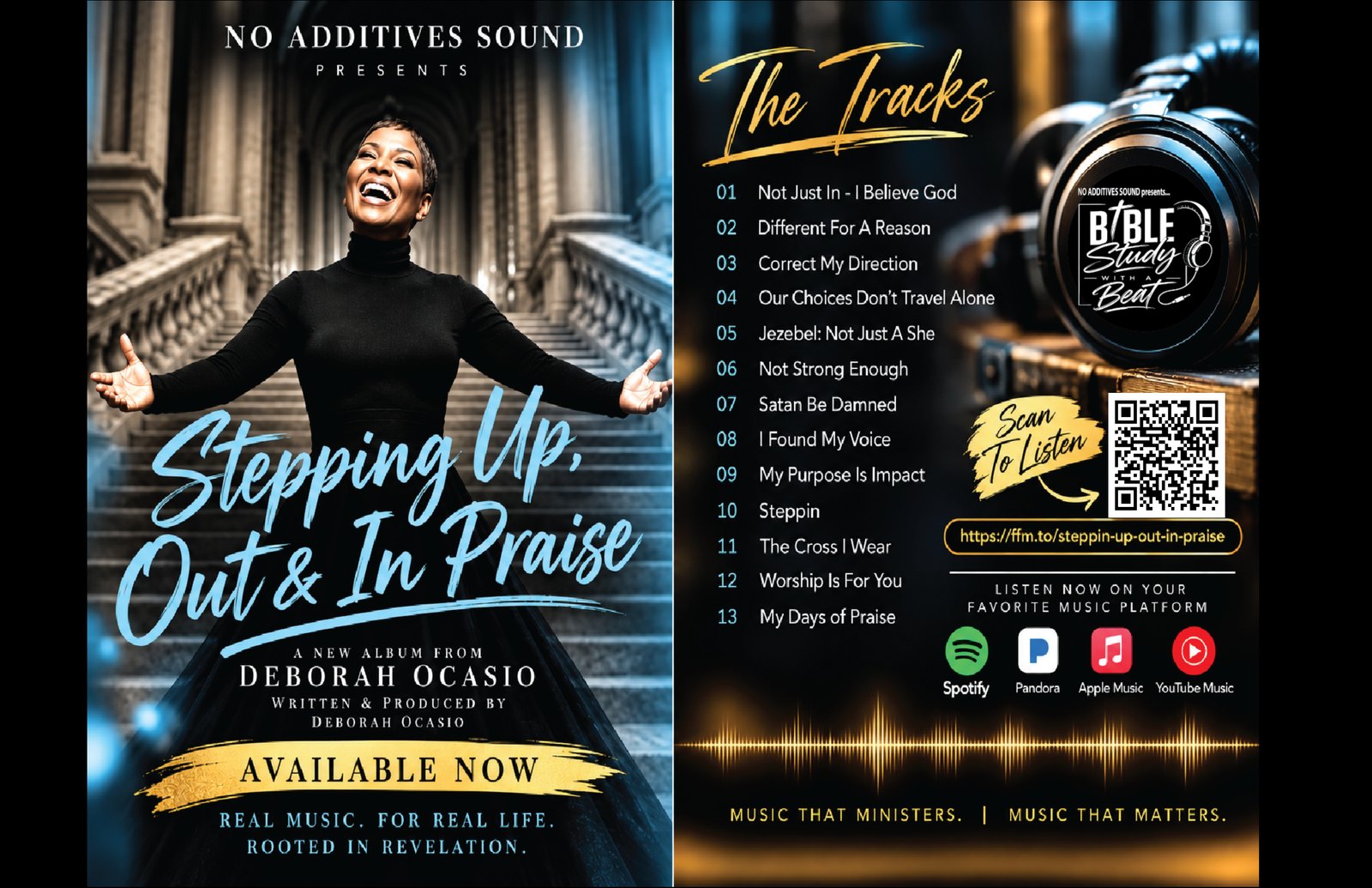
Stepping Up, Out & In Praise
Deborah Ocasio's album — the full tracklist and a scan-to-listen link ran as a two-page spread in print.
Listen now